
When housing is scarce, REITs profit
It’s a common trope to say that building new market housing benefits real estate investors, specifically REITs (Real Estate Investment Trusts). But is this true?
In a word, no. Building more housing puts downward pressure on housing costs, an effect which is extremely well documented. If you want to see the evidence, there are a number of links at the bottom of the post, the first of which is an article talking about the problem in plain English, with more academic sources following.
The short explanation for why is that new market rate housing helps prevent wealthier people from moving into older, less expensive housing and displacing the existing tenants. It also helps increase the vacancy rate, which is closely linked to housing costs. If you want a more in depth explanation, I would suggest reading the first source below, which I’ll also link here.
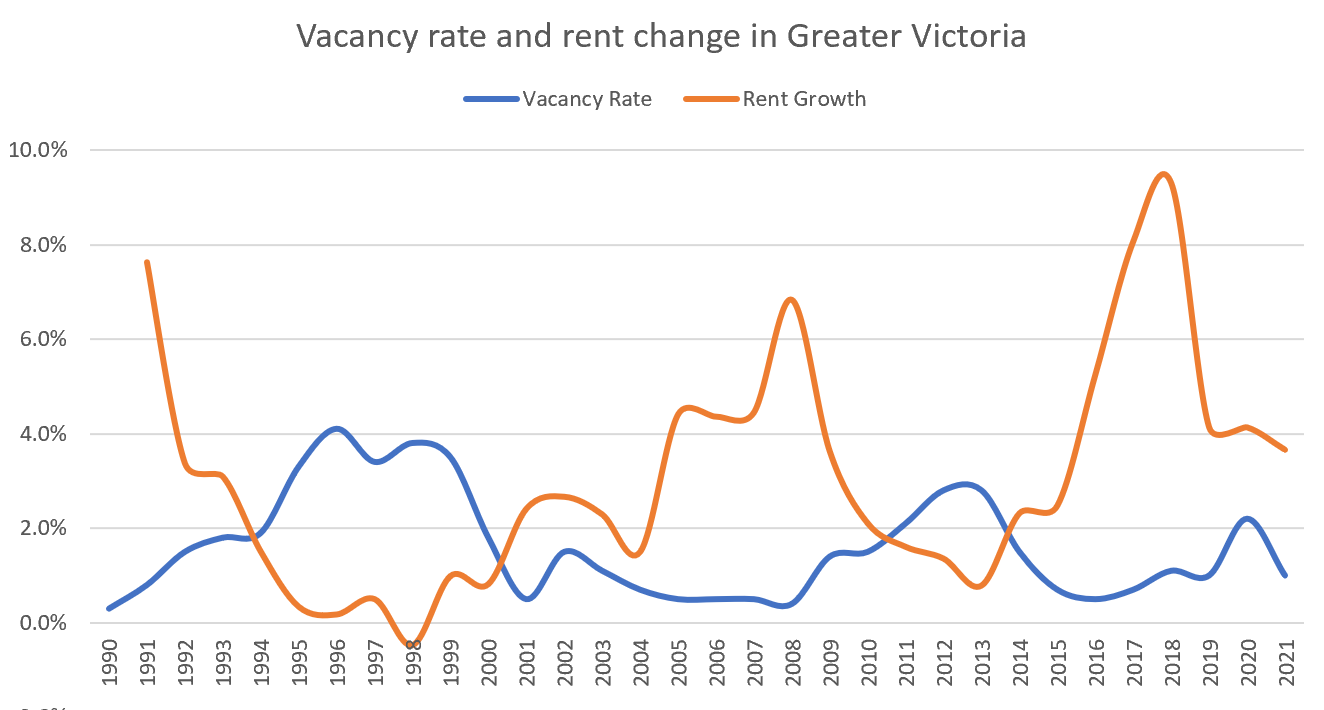
Higher vacancy rates, low rent increases. Lower vacancy rates, higher rent increases. Image credit to House Hunt Victoria.
Given that new housing puts downward pressure on housing costs, it would seem that REITs would actually be harmed, not helped, by new housing construction. And there’s no better place to see that than the words of REITs themselves. Publicly traded companies are legally required to disclose their basic business strategy to potential investors, and these disclosures are fascinating to read.
Consider Minto REIT, who state that “Significant barriers to entry protect incumbent owners from increased competition and continue to contribute to favorable supply/demand fundamentals… [this] supply constrained market creates a compelling investment opportunity for investors.” Link here.
Or you could listen to Killam Apartment REIT, who state that “with population growth and demand out-pacing the housing supply in our core markets, Killam had a very successful year of high occupancy and optimizing rental rate growth”, and “Killam's Halifax apartment vacancy rate were at record lows, and market rents continue to increase.” Link here.
In other words, not only is a limited supply of new housing not a threat to these companies, it is a core component of their business strategy.
Of course, it would be ridiculous to claim that new market housing is the only solution to the housing crisis. The government has an extremely important role to play by providing deeply subsidized housing for people with lower incomes, shelters for those on the streets, and many more things that the market is unable to provide.
But to claim that new housing doesn’t help lower rent is to deny an overwhelming and thorough body of academic research. You can’t hoard and increase the price of something unless it’s scarce, which is why REITs invest heavily in markets that constrain the supply of new housing. Institutional landlords and other entities that benefit from the housing crisis understand very well how this system works. If we want to beat them and solve the housing crisis, we don’t need to like this system, but we do need to understand how it works. They certainly do.
Sources:
https://jacobin.com/2024/10/vancouver-zoning-single-family-apartments
https://killamreit.com/sites/default/files/financial_reports/KMP%2002.23.22-AR-Final.pdf
