
Who should pay for growth?
In discussions surrounding new housing, one of the most common things to hear is that we should make developers pay for new infrastructure like sidewalks or road dedications (“Growth pays for growth”). After all, they're making all this money off of new developments, why shouldn't they be forced to give a little back? This is what DCCs (Development Cost Charges) and all the other taxes, charges, and fees municipalities place on new homes are intended to do. The idea is that municipalities charge developers money per home they build through DCC’s, and use that money to build critical infrastructure. Sounds smart, right?
Unfortunately, this story falls apart pretty quickly when you look into who actually pays these taxes, and what their overall effect is on housing costs. When we place taxes on new housing, the developer doesn't pay them. In fact, sometimes they even make money from them.
Note that I use DCCs in this post to refer to any charges, taxes, or fees placed on new construction housing by municipalities. While these tools differ administratively, they share the same economic effects in supply-constrained markets like ours. These tools have nuance, but none that matters for the purposes of this discussion.
Who actually pays the taxes on new housing?
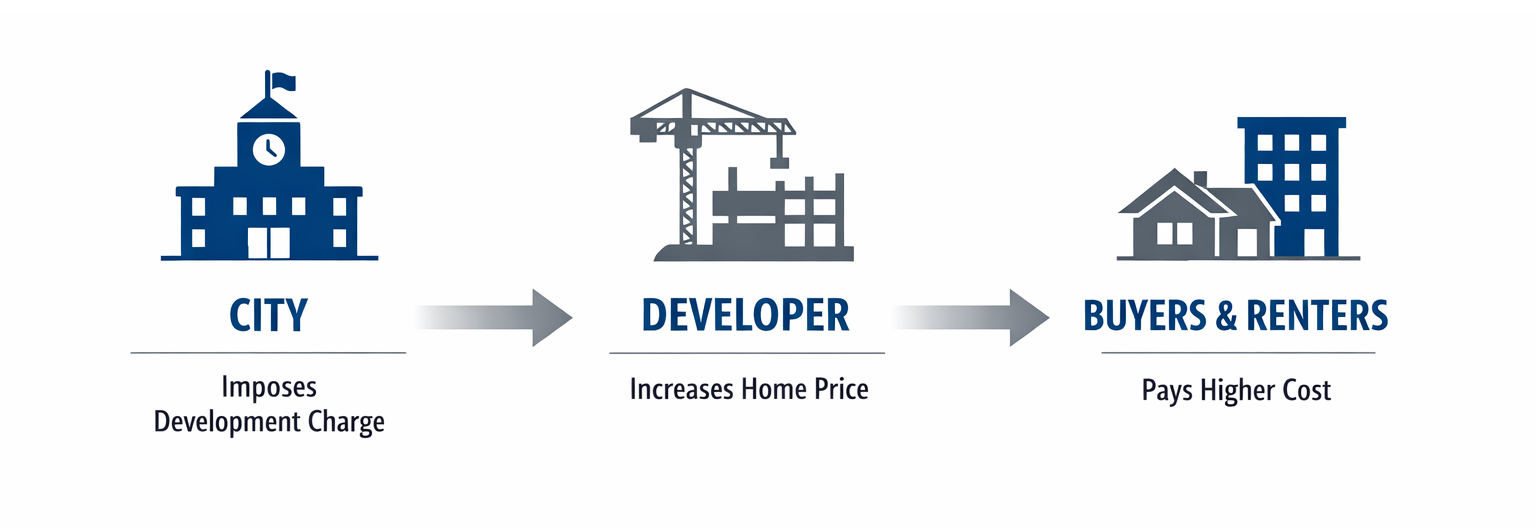
Imagine you're a business owner who manufactures a product for $10, and you sell it for $12. One day, the government decides to place a tax on the creation of your product, raising the cost to produce it from $10 to $11. Would you stomp your feet and say "rats, my profits just got cut in half", or would you raise the price by roughly $1 to compensate for the increased cost?
Maybe you're personally very altruistic, or just really care about delivering a good product to your customers. But 99% of business owners don't just accept reduced profit margins if they don't have to, and developers are no different. When the cost to produce their product goes up, they increase the sale price to compensate. The result is that, in supply constrained markets like Victoria, the person ultimately paying for that tax increase is the consumer (new homebuyers and renters), not the developer. This is functionally pretty much identical to Trump implementing tariffs while saying other countries are the ones paying, when in reality it’s American consumers that end up footing the bill.
And it can go one level further; most businesses don't pass on the exact cost of inputs, they add a markup, and many developers do the same. That means that if a city charges $50k in taxes on new housing, the developer might pass on $60k to the consumer, profiting the extra $10k. So not only do these new charges not result in developers paying anything, they can actually increase developer profits. A policy meant to capture developer profits for community amenities which actually ends up increasing the cost of new housing and punishing new homebuyers and renters doesn’t sound like a good idea to me.
You don’t just have to take my word for it. The CMHC recently released a report demonstrating that this does in fact happen in reality. And it gets worse! Not only do DCCs and related taxes get paid by new homebuyers instead of by developers, and they increase the cost of new housing, they also increase the cost of existing housing! If you don’t feel like reading the entire report (though you should, it’s not long), I’ve copy-pasted the highlights below;
New homebuyers bear the burden of the development charge. This is especially true when housing markets are trending upwards.
Studies show increases to new house prices are typically proportionate to, or greater than the size of the development charge
Prices of existing homes also rise, and at a high magnitude.
Sellers of existing homes can ask for a higher price if newer homes in the area are selling at an increased price, even though development charges are only applied to new construction.
This points to an equity benefit for existing owners.
The price of undeveloped land increases in many studies, though it’s not always the case.
Land values can decline if increased development costs draw down from a developer’s willingness to pay for a plot of land.
Development charges may substitute for increases in property tax (or other fees), lowering the potential costs of existing homeowners. An overreliance on development charges may produce a less diverse mix of revenues for growth-related infrastructure, potentially lowering the potential costs on existing homeowners in favour of fees on new homeowners.
So DCCs make new homebuyers and renters pay instead of developers, they drive up the cost of both new and existing housing, and they can even increase the cost of undeveloped land. This worsens the housing crisis, which effectively acts as a tax on the entire region. More expensive rent raises the cost of goods as businesses need to pay their employees more, healthcare becomes less accessible because nurses and doctors move away, and so on. I don’t need to lecture you about the enormous number of negative consequences we suffer from our housing crisis.
Clearly, if we care about solving the housing crisis, DCCs and other taxes on new housing are not the right tools for the job.
Why keep them? The primary reason given is that “growth should pay for growth”. The idea is that existing homeowners shouldn’t have to pay for infrastructure required for new growth. DCCs shield existing homeowners from higher property taxes by pushing those costs onto those not lucky enough to already own property. I’ll address whether this is a good goal to have in a minute, but for now it’s worth asking whether or not DCCs even accomplish the goal in the first place.
Do DCCs make growth pay for growth?
I’ve lived in Greater Victoria since I was two, with the vast majority of that time being in Victoria proper. Despite being “growth”, I have never paid a dime in DCCs. I’m a renter, and have never rented a new construction home. So long as that remains true, I’ll never (by this logic) pay for the increased infrastructure demand I’ve placed on the region. Even if I do buy a home, as long as I don’t buy a new construction home, I still won’t pay anything in DCCs. The only situation where I’ll be subject to this mechanism for infrastructure funding is if I buy a newly built home. How is that fair? Have I contributed less to the need for infrastructure by renting? Do I contribute more by buying a new home vs an existing one?
DCCs are not a good tool for accomplishing their stated goal. And while municipalities aren’t well equipped to raise revenue thanks to limited options given to them by the province, using the wrong tool for the job can be worse than doing nothing. If the overall effect of using DCCs is negative, we shouldn’t be using them.
Who should pay for growth?
As previously stated, the whole concept of DCCs relies on the assumption that “growth should pay for growth”. I disagree with this assumption. I believe it ignores the positive aspects of growth, and that in doing so it harms not only new homebuyers, but existing residents as well, leaving everyone worse off.
Growth obviously brings costs, and somebody has to pay them. Infrastructure (note that this includes more than just roads and pipes, but also schools, parks, and everything else required for society to function properly) isn’t free. It can seem like a ripoff for existing residents to have to pay for the infrastructure required to grow.
But growth also brings many benefits, especially in a place like Victoria. Growth means more customers for local businesses, a reduction in environmentally devastating urban sprawl, and more neighbours to meet and build relationships with. These benefits are significant, enjoyed by all, and shouldn’t be ignored.
Existing residents also often get to use the new infrastructure that they pay for. This obviously doesn’t apply to things like new water connections, but new parks or roads or community centers aren’t exclusively for new residents.
Most importantly for this discussion, in a built-up city like Victoria, growth means dense urban infill development, which means shifting from land uses which are a financial net-negative to ones which are a net-positive. You can read more about this here. The short version is that single family homes don’t generate enough revenue from property taxes to pay for their own infrastructure, costing the city money, while denser land uses generate more in revenue than it costs in infrastructure, meaning they makes the city money. This means that in cases like ours, growth does in fact pay for growth. And it does so in a much more sustainable way; DCCs are one and done, while property taxes are predictable and reliable sources of income for decades, which is vastly superior. This concept, incidentally, is why so many companies have been shifting to subscription models over the past decade or so.
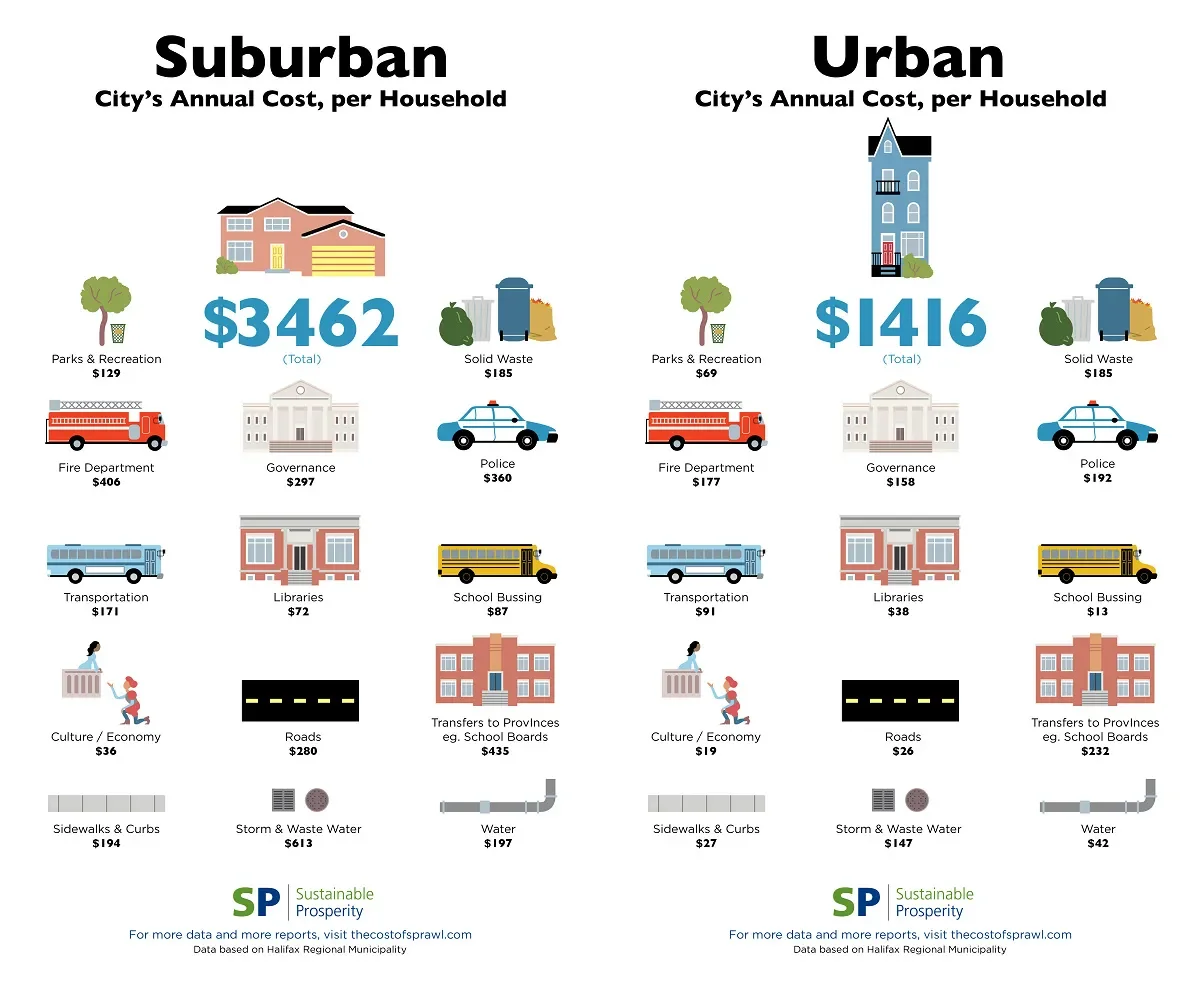
This is just expenses, this doesn’t even account for the increased revenue!
Where do we go from here?
Obviously, DCCs are a meaningful source of revenue for many municipalities right now, and times are tough financially. It would be unrealistic to suggest that municipalities immediately remove all DCCs on new housing. We could reduce a lot of the downsides by implementing a Direct-to-Buyer system, if the province decides to allow municipalities to do so. At the very least, we need to stop making the housing crisis worse by increasing DCCs, and start to chart a course to a world without them. Municipalities that currently function without DCCs, such as Esquimalt, should not add them. While property taxes certainly aren’t an ideal way to generate revenue, they’re far more equitable and sustainable than DCCs.
