
Why housing matters so much
We're facing a lot of problems as a city. Too many of our neighbours are homeless, local businesses are struggling, our transit system isn't keeping up with demand, and pretty much everything is getting more expensive. That's before even getting into climate change, traffic, taxes, or Canada's stagnant economy.
So why do I spend so much time talking about housing?
Because the Housing Crisis is the Everything Crisis.
I don't mean that housing is literally the cause of every problem we have. Obviously it isn't. But take almost any major problem we're dealing with right now and you'll find that the housing crisis is making it worse. That's daunting, because it means a lot of these problems are going to be very difficult to properly solve until we get housing under control.
But there's another way of looking at it. Progress on housing gives us automatic free progress on a whole bunch of other problems at the same time.
Build enough housing to take some pressure off rents and people have more money left over for groceries. Let more people live near their jobs and traffic gets better. Build more homes on land we've already developed and we spend less on infrastructure while putting less pressure on forests at the edge of the region. Make housing cheaper and fewer people fall into homelessness, while those who are already homeless have a much easier path back into housing.
Housing won't fix everything. But getting it right makes almost everything else easier. It helps with so many things that I can’t even fit them all into one post, so the following points will have to suffice.
The affordability crisis
The most obvious problem with expensive housing is that housing is the biggest expense most people have. But what makes housing particularly important is what it does to every other part of someone's budget. Housing is one of the few things you can't really opt out of buying. If steak gets too expensive, you can eat something else. If restaurants get too expensive, you can eat at home. You can cut back on plenty of things when money gets tight. You still need somewhere to live.
That's why housing acts as an amplifier for basically every other affordability problem. A 20% increase in grocery prices hurts a lot more when half your income is already disappearing into rent than it does when you're spending 25% of your income on housing. The same goes for childcare, gas, electricity, insurance, or pretty much anything else.
Two people making exactly the same salary can have completely different standards of living if one pays $1,200 a month for housing and the other pays $2,500. That difference determines whether someone can save for retirement, have kids, eat out occasionally, support local businesses, or absorb an unexpected $1,000 bill without going into debt.
Local government can’t make groceries free or get gas back to 50 cents a litre. But if we can knock hundreds of dollars off the biggest monthly expense people have, everything else becomes easier to afford.
Homelessness
Homelessness is complicated. Mental illness, addiction, domestic violence, inadequate tenant protections, poverty, and a broken healthcare system can all play a role. But it's foolish to pretend the price and availability of housing don't matter. When the cheapest housing gets more expensive, more people who are barely hanging on lose their homes. Once somebody becomes homeless, getting them housed again becomes much harder when even the cheapest room or apartment is wildly unaffordable.
Canadian research released in August 2026 looked at 36 communities across the country and found that homelessness increased the most in places where the cheapest rental housing became more expensive and harder to find. This sounds obvious, but it’s important to hammer it home since some people refuse to accept the connection here.
That doesn't mean housing is the only answer, people wind up homeless for all sorts of reasons. Someone with severe mental illness still needs proper mental healthcare. Someone struggling with addiction still needs treatment. Someone fleeing abuse needs somewhere safe to go. But eventually, all of those people still need somewhere to live. There is no realistic plan to seriously reduce homelessness that doesn't include making housing more abundant and affordable.
Families
The housing crisis is particularly brutal for families. The vacancy rate for 3+ bedroom homes in Saanich is, at the time of writing, ZERO percent. A studio or one-bedroom apartment might be perfectly fine for one person or a couple. Throw one or two kids into the mix and suddenly an extra bedroom isn't some luxury item. At the same time, a lot of the homes that actually have enough bedrooms for families are occupied by people who don't really need that much space. I was one of them!
When I lived in Gordon Head, I rented a detached house with four friends. The house sucked, but it was cheap, so it worked for us. Five adults could split the rent and we each had somewhere to live. But that same house could also have been a home for a family. We weren't living there because five unrelated adults have some inherent need for a detached house and a yard, we were living there because there weren't enough smaller, reasonably priced options available to us.
This is why I get frustrated when density gets reduced to a debate about towers full of tiny condos. Yes, we need apartments. We also need townhomes, rowhomes, houseplexes, co-ops, and larger two- and three-bedroom apartments. We need smaller and cheaper homes for students, young workers, couples and roommates too. There's an enormous amount of housing typologies between a one-bedroom condo and a million-dollar detached house. For decades, we've made much of it extremely difficult or outright illegal to build.
Building smaller homes doesn't mean forcing families into shoeboxes. It’s about giving everyone else enough options that families aren't competing with five roommates for the same four-bedroom house.
Victoria and other municipalities have acknowledged the problem locally too. The City has been losing young families and has pointed to the lack of housing that fits their incomes and allows them to grow as a likely reason. That matters beyond the cost of rent. People move farther from grandparents who could help with childcare. Parents spend more time commuting and less time with their kids. Children leave schools and friends because their family can't afford to stay. Neighbourhoods become increasingly divided by income and age.
If we want Victoria to be a good place to raise a family, playgrounds, schools and childcare are important. So are homes families can actually afford to live in, and making them available means making housing abundant for everyone.
Local businesses
Local businesses need workers, and they need customers. The housing crisis makes it harder to find both.
If a restaurant, construction company, daycare, retail store or any other business can't pay enough for its employees to live anywhere nearby, its potential workforce shrinks. People turn down jobs. They leave the region. They take work closer to wherever they can afford to live. Businesses operate short-staffed, reduce their hours, pay more to recruit people, or decide not to expand at all.
This isn't some hypothetical future problem. Victoria has been dealing with it for years. The City's own Housing Strategy says employers regularly report that housing costs make it harder to recruit qualified workers, particularly for small businesses. The Greater Victoria Chamber of Commerce lists attainable workforce housing as one of its major advocacy priorities for the same reason.
Then there are the customers. Put hundreds of people within walking distance of a cafe, pub, corner store, barber, restaurant or grocery store and you give that business a built-in customer base. People don't have to make a special trip across town. They can stop on the way home from work, while walking the dog, or after picking up their kids.
But those customers also need money to spend. If another $500 of someone's paycheck disappears into rent every month, that's $500 they aren't spending at restaurants, bookstores, coffee shops, bike shops, or anywhere else in the local economy. If we want independent businesses to survive in Victoria, the people who work at them and the people who shop at them need to be able to afford to live here.
Productivity
Canada has had a productivity problem for a long time. There are a lot of reasons for that, but housing is part of it. When simply owning real estate has been such a good investment for so long, it shouldn't be surprising that enormous amounts of money have flowed into real estate instead of businesses, equipment, technology and other things that actually make us more productive.
We've spent decades congratulating ourselves as our houses became more valuable. For an individual homeowner, that seems great. But your house going up by $100,000 doesn't mean it suddenly got $100,000 better at being a house. We didn't invent anything. We didn't build a factory. We didn't train a worker or develop a new technology. The same asset just became more expensive.
A country cannot build long-term prosperity by endlessly selling increasingly expensive houses to each other.
Taxes
One of the best ways a city can keep taxes under control is by using land and infrastructure efficiently. Spread people and jobs farther and farther apart and you need more roads, more pipes, more power lines and more infrastructure per person. Somebody has to pay to build and maintain all of that. Low-density housing is particularly expensive to service. Single-family homes don't generate enough property tax revenue to cover the long-term infrastructure needed to serve them, meaning denser development ends up subsidizing them.
That matters even more now. Construction costs have massively increased over the past several years, while a huge amount of infrastructure built decades ago is reaching the point where it needs major repairs or replacement. A 2021 fiscal analysis commissioned by the City of Ottawa found that new low-density single family development cost the city $465 per person per year, while high-density infill made the city $606 per person per year in net revenue. Metro Vancouver has estimated that on-site infrastructure for a single-family house can cost five to nine times as much per person as infrastructure serving an apartment development.
This doesn't mean we need to bulldoze every detached house and replace it with a 40-storey tower. Nobody is proposing that. Townhouses, rowhomes, houseplexes and low-rise apartment buildings all use land and infrastructure much more efficiently while still fitting comfortably into existing neighbourhoods.
If we want to keep taxes down, this issue is important. If we want government to have enough money to improve services, it's important too. Either way, building our city more efficiently is absolutely critical.
Transit and traffic
Where people live determines how they get around. If people can live reasonably close to work, school, shopping and everything else they do, walking, biking and transit become realistic options. Spread everything farther apart and driving becomes the only practical choice for most people. Then we act surprised when there's traffic.
At a certain point, this is just geometry. Cars take up an enormous amount of space. There is no realistic way for everybody in a city of any meaningful size to drive everywhere without running into congestion. Cities have been trying to solve this problem for generations. The ones that give people lots of different ways to get around tend to function much better than the ones that build endless low-density suburbs and then try to fix the resulting traffic with wider roads.
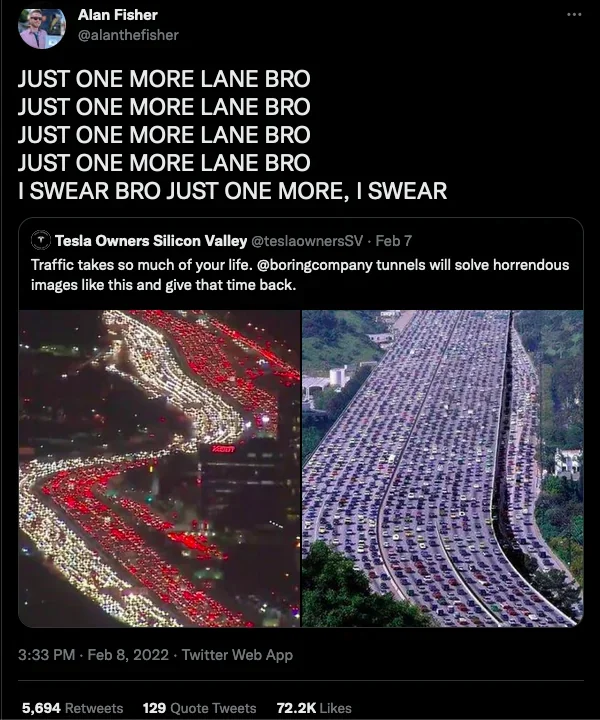
That doesn't mean nobody should drive. Cars are incredibly useful. I'm an electrician. I'm very aware that there are jobs, trips and circumstances where carrying a bunch of tools onto a bus isn't exactly practical. The problem is treating cars as the default answer for almost every trip.
If someone can walk ten minutes to the grocery store, bike to work, or take a frequent bus instead of driving, that's one fewer car in front of the plumber hauling tools across town, the parent picking up their kid, the delivery driver, the person with a disability, or anyone else who actually needs to drive. Giving people alternatives to driving is good for drivers too.
Land use also has a huge effect on the quality of transit we can provide. A bus route through a neighbourhood where thousands of people live can carry lots of passengers and justify frequent service. Spread that same population across a huge area and suddenly you need longer routes, more buses and more drivers to provide worse service. Density doesn't automatically create good transit, but good transit becomes much harder without it.
Climate
A surprising number of people seem to think dense housing is inherently bad for the environment. That is exactly backwards.
The thing that gets missed in these conversations is that people have to live somewhere. If Victoria refuses to build housing, the people who would have lived in those homes don't disappear. In a region that continues to grow, a lot of that housing simply gets built farther away instead. Often that means paving or clearcutting land on the edge of the region.
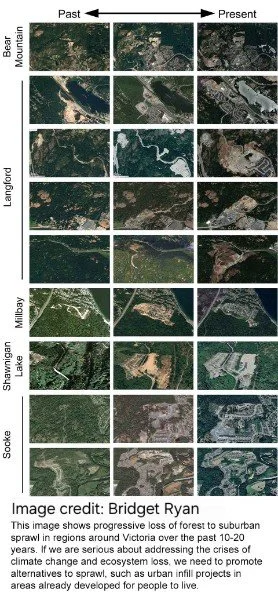
I started my electrical apprenticeship building single-family sprawl in the Westshore. It was genuinely depressing seeing how much natural land was being destroyed to build housing that way. We talk a lot about protecting trees in urban neighbourhoods, and we should. Urban trees are hugely valuable. But we can't get so focused on protecting every individual tree in the urban core that we ignore acres of forest being cleared somewhere else to house the people we refused to make room for here. We risk literally missing the forest for the trees.
Suburban sprawl also makes driving the default for almost everyone who lives there. Even if every vehicle on the road became electric tomorrow, that would still come with a huge environmental cost. EVs are better than gas-powered cars, but they're still large machines that require roads, parking, energy and huge amounts of material to manufacture. They still create pollution from tires, brakes and road wear. Electrification helps, but it does not make car dependency environmentally harmless.
Denser neighbourhoods make walking, biking and transit much more practical. Compact, walkable cities where homes, jobs and services are closer together are associated with lower greenhouse gas emissions. Dispersed, car-oriented development means longer trips, greater energy use and much more difficulty shifting people away from driving.
There are efficiencies in the homes themselves too. Attached homes can share walls, roofs, foundations and other infrastructure. They use less land per person, and smaller homes generally require less energy to heat and cool.
None of that means every tall building is automatically green. Density isn't an excuse to ignore urban trees, parks, building efficiency or construction emissions. It means you can't judge the environmental impact of a neighbourhood based on how green it looks from the sidewalk. That's especially important in Greater Victoria. We can preserve an urban lot exactly as it is. But if the result is that several households instead end up in a new subdivision carved out of undeveloped land on the edge of the region and drive dozens of kilometres every day, we haven't eliminated the environmental cost. We've moved it somewhere we don't have to look at it.
Housing and climate policy are deeply connected. A detached house surrounded by trees may look environmentally friendly in isolation, but once you zoom out and look at the whole system, denser urban living is far easier on both the climate and the natural environment.
Conclusion
This is why I talk about housing so much.
Building more housing won't fix our mental healthcare system. It won't cure addiction, make groceries cheap, eliminate traffic, solve climate change, save every local business, or magically reverse Canada's productivity problems. Anyone telling you housing alone will do all of that is overselling it.
But that's not the point. The point is how many problems get easier when we get housing right. When housing costs less, people have more money left for everything else. When people can afford to live near their jobs, businesses have an easier time finding workers and our transportation system works better. When we build homes on land we've already developed, infrastructure costs less and there's less pressure to clear forests on the outskirts of the region. When families can find homes that actually fit them, they don't have to leave their communities. When workers can move to where their skills are most useful, the economy works better. And when somebody falls on hard times, the existence of an available home they can actually afford can be the difference between a temporary setback and homelessness.
Of course, what we build matters. We need deeply affordable public and non-profit housing for people the private market is never going to adequately serve. We need co-ops. We need purpose-built rentals. We need more homes big enough for families. We need tenant protections so the people already living here aren't sacrificed in the process. And yes, we need the private sector to build a hell of a lot more housing too.
There’s no silver bullet here, we need silver buckshot. There isn't one level of government that can solve this by itself. And there isn't one type of housing we can build that fixes everything. What we can stop doing is treating housing like one isolated issue competing for attention with everything else.
Housing is where people live. Where they live affects how they get around, what jobs they can take, how much money they have left at the end of the month, what infrastructure governments need to build, how much energy they use, whether they can raise a family here and, in the worst cases, whether they have a home at all.
We have an enormous number of problems to solve. Making housing abundant and affordable won't solve them for us, but it will make nearly every one of them easier.
That's why the Housing Crisis is the Everything Crisis.
